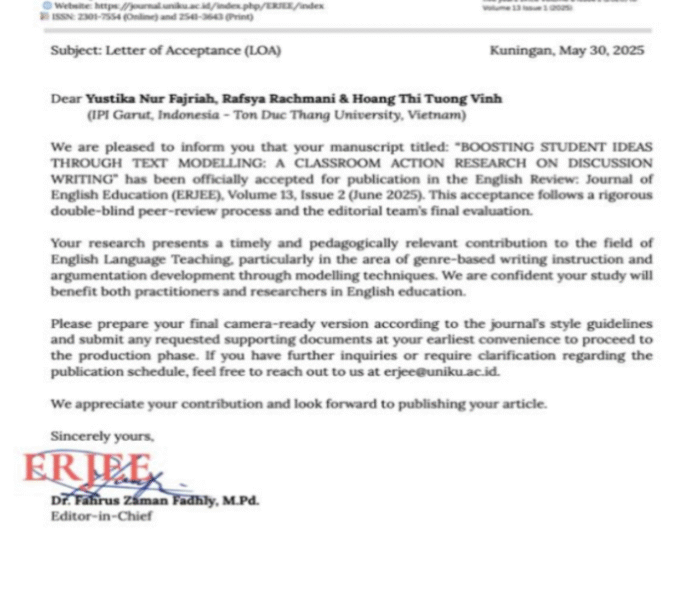
Garut - Indonesian Institute of Education Institut Pendidikan Indonesia (IPI) Garut continues to strengthen its international network by establishing strategic partnerships with Ton Duc Thang University (TDTU) Vietnam. This collaboration materialized through the joint publication of a scholarly article, conducted from December 2024 to February 2025. The primary focus of this research is language education, with the aim of producing scientific publications that make a significant contribution to the development of literacy and more innovative learning methods. This program not only enriches the academic insights of both parties but also serves as an important part of the internationalization efforts currently promoted by IPI Garut and TDTU.
This collaboration involves three primary authors: Dr. Yustika Nur Fajriah, M.Pd. and Rafsya Rahmani from IPI Garut, and Hoang Thi Tuang Vinh from TDTU. The writing process was conducted online using various digital platforms to ensure smooth communication and coordination despite differences in time zones and geographical locations. The authors engaged intensively in conceptual discussions, literature review, and the development of the manuscript, which is expected to be published in an internationally reputable academic journal. This research focuses on language teaching, both first language and foreign language instruction, with the hope of providing substantial theoretical and practical contributions to education in both countries.
This collaboration has brought significant impact to IPI Garut, providing opportunities to expand its international academic network and enhance the quality of research and scientific publications at the global level. In addition, this initiative serves as a platform for lecturers to strengthen their professionalism through the exchange of knowledge and research experience with international colleagues. The program opens broader opportunities for continued joint research and for enriching inclusive and sustainable educational quality. Although challenges such as time zone differences and scheduling live discussions initially posed obstacles, the use of online communication technologies proved effective in ensuring efficient and productive collaboration. With the manuscript expected to be published in an international academic journal, future evaluations will focus on improving coordination and communication to maximize the potential of this partnership moving forward.